
CRITICISM AGAINST THE OFFICE OF THE
CHAZAN THROUGHOUT THE AGES
In the early Middle Ages, the office of the Chazan was held in high esteem. By the sixth century, Jewish learning had diminished, and knowledge of the Hebrew Language became a rarity. Few were left who were capable of officiating as honorary leaders of the Service. It was therefore left for people of Torah knowledge, the Payyetanim; teachers, and scholars, to lead the people in Prayer.
During the seventh century, greater changes in the Synagogue Service occurred. Liturgical poetry was introduced into the Prayers by Payyetanim such as Yannai and Eleezer HaKalir, which was poetry written in a metrical style and in Classical Hebrew, difficult for the masses to understand. The melodies with which the Piyutim were sung were popular, although not always of a Jewish origin.
The Rabbis were primarily concerned with the meaning and the purpose of the Prayers. They felt that the new melodies distracted, rather than enhanced, the attention and concentration of the Cantor and the worshipper. Hence, a major conflict in the format of the Service began: the Rabbis, on the one hand, tried to maintain the serious content of the Service, and looked askance upon all attempts to introduce elements which would distract worshippers from this purpose. On the other hand, the Cantor tried to reflect and respond to the mood of the times. Seeing that the masses did not understand the language in which they prayed, they felt they could best serve by making the Congregations chant prayers together. They gave free rein to their own artistic temperament, in order to bring melodic beauty to the Service.
It appears that no other communal official occasioned so many complaints and frequent criticism as the Chazan in the Middle Ages, as well as in the late Middle Ages. This was due to the fact that Chazanim, namely Payyetanim, on their own accord, introduced new prayers without the consent of the Rabbinical authorities. They took upon themselves the prerogative of reciting these new Piyutim with new melodies and with non-traditional tunes.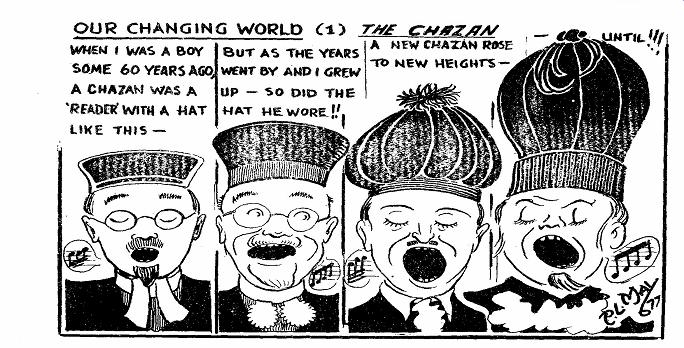
There are many protests recorded against such abuses in the Responsa (Sh’eilot U’t’shuvot), namely the ‘Sefer HaChassidim’ by Alfasi, the ‘Morei N’nuchim’ by Maimonides, ‘B’samim Rosh’ by Asher ben Yechiel, all of whom protested in vain that traditional melodies were changed by the Chazanim either deliberately or unconsciously, according to their own individual taste, often very poor!
Many Rabbis were intolerant of the artistic virtues of the Chazanim. The more original the Cantor was, the more likely he was to bring non- Jewish music into the Synagogue Service. His artistic nature appreciated the beauty of the melody, no matter what the source, so long as it fitted the content of the prayer.
Rabbis lacking a musical sense were resentful of such changes in the Service. They attacked this secular intrusion by saying that Chazanim had no right to introduce theatrical melodies into the Service. The Gaonim stressed that all non-sacred music, vocal or instrumental, was forbidden. In the commentary of the ‘Magen Avcraham’ by Avraham Gunbiner, it is stated:. “The vanity of the Chazanim led them to prolong unsuitable single notes and insert interludes of songs out of context”. He complained mainly of the ‘M’sor’rim’, who had already in ancient times, been rebuked for prolonging tunes and distorting the meaning of the Prayers.
We find an ironic comment in the ‘Midrash Kohelet’, using the words of ‘Kohelet’ himself: “It is better to hear the rebuke of the wise than to hear the song of fools” (Eccl. 7/5).
Many great scholars of later centuries such as the ‘Bet Yosef”, who wrote a commentary on the ‘Orach Chayim’, Isaiah Horwoitz, in his work ‘Sh’nei Luchot hab’rit’ (Section T’filah), as well as many others, complained on this score, but all to no avail. Some of these were sincerely troubled, pointing out that the morality of the Chazanim was not always of the highest, and that they were continually being censured for their vanity.
Abraham ben Shabtai Horowitz in his work on Ethics, ‘Yesh Nohalim’, even recommended the study of the ‘Turim’ or the Mishna, during those sections where the Chazan was accustomed to prolong his singing!
The author of ‘Reishit Bikurim’ (seventeenth century) enumerated a long list of ‘offences’ of which Chazanim were guilty: one was their habit of placing their hand on the chin or throat while singing, to facilitate trilling, or singing with a head-voice, like a woman, to enable them to produce high notes, beyond their natural raige. Yet anther fault cited was the placing of the hand over the ear, the better to hear themselves.
However, all those faults which were listed in the vast literature of the Responsa, did not exist to the same extent in Sephardic Congregations, mainly because they did not have as many Piyutim in their Machzor, thus giving less opportunity for individual singing. Their Services, as is known nowadays, were well ordered, and consisted mainly of Congregational chanting, alternated by the verbal recitation of the Chazan.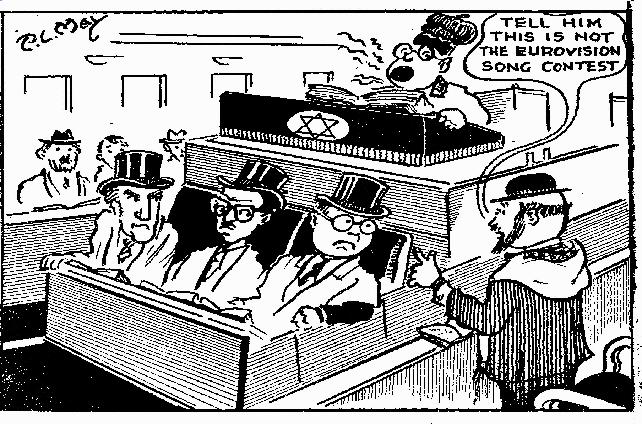
Even at the beginning of the fourteenth century, it was known In Spain that Jews from the better families no longer seemed to have a ‘call’ for the position of Chazan, which served to indicate that this position was no longer held in high esteem.
Rabbinical authorities in Germany were greatly outspoken against the ‘modern’ Chazan. Whenever they wrote about ‘T’filah’ or ‘Minhagim’, they could not lose the opportunity of mentioning their dissatisfaction with the Chazanim of their time.
It seems that the very negative attitude of the Rabbis towards Chazanim stemmed from the fact that the Chazan of old, like the Chazan of today, was not bound to adhere to written music, and to certain rules in singing the various Nusschaot and the traditional melodies, but used his own Imagination to improvise tunes.
It is known that Chazanim in early times used to place the Talit over their heads, a procedure which is still a Minhag among many Chassidim. In one of the Histories of the German Jews, ‘M’korei Minhagim’, written by Lewyson in Berlin in 1846, it is mentioned: “The Chazanim frequently brought down the Tallit upon their shoulders in the midst of the prayers in order to observe what impression their singing had made upon the Congregation”. The writer must have thought on similar lines to the Rabbis, for he did not question those Chazanim as to the possible reason: perhaps it was because of the heat, or to ‘take a breather’ ? !
A certain witticism was told by a London Dayan: “A Chazan asked the Baal Shem Tov what to do in order to avoid ‘thoughts of vanity’, during the prayers, for he always contemplated after each prayer what impression it had made oni the Kahal. In doing so, he confessed, he could not concentrate on the true Kavanah of the prayers. The Baal Shem Tov advised him: “I suggest you uncover your head from time to time, look around, and realise how the people laugh at you.”
It is a rather undignified tale, tasteless even, as told by a Dayan, to a distinguished audience. It is not clear why on earth Rabbis should involve the Baal Shem Tov.
In his work ‘Lebenshalter’, Low (nineteenth century) states: “The immoderate raising of the voice of the Chazanim, their incorrect pronunciation of Hebrew, and the drawing out of their singing were constantly subjects of complaints among Rabbis”. Low continued in the same vein: “Their method of singing has been justly called a ‘pilpul set to music.’ This was probably a reference to frequent use of coloratura. Low continued: “The prolongation of the Service was always a cause for general weariness, turned the Synagogue into a ‘conversing crowd’ rather than a praying Congregation, resulting in distortion of the real meaning of ‘T’fillah B’zibbur’.
The Rabbis of old, like those of today, complained that it was the fault of the Chazan that people conversed because they got impatient with the long service. It seems that the only time people do not talk is when the Rabbi delivers his Sermon! However, many Chazanim feel that it is easier for the masses to listen to the chanting of the Chazan than to the monotony of the preacher!
The author of the ‘Chayei Adam’, Rabbi Abraham Danzig of Vilna (1748) mentioned in his work the importance of selecting a Shaliach Zibbur for the High Festivals (see Hilchot Rosh Hashanah Klal 138, Siman 4) “It is important to be strict in choosing a Chazan for the Yamim Noraim who will be most worthy morally and ethically, and known to be a person of good deeds and good manners (Midot Tovot). He ought to be at least thirty years of age, for he would not then be inclined to the force of the Yezer Hara. He should be married, and must have a good knowledge of the T’fillot”.
Furthermore, the ‘Chayei Adam’ makes the complaint in the name of the ‘Magen Avraham’: “It is grieving for me to see that some communities appoint a Sshaliach Zibbut whose only virtue is possessing a nice voice, and whose only purpose the singing of melodies without having sincere Kavanah during the prayers”. He also mentioned that the ‘Magen Avraham’, quoting the ‘Rashal’ (Rabbi Shmuel Luria) said: “The Chazanim who prolong their singing of the prayers are neither devoted to God nor to their fellow men”. Moreover, he quoted a Gaon who attacked those Chazanim whose intention, while rendering the Service was only to bring out a beautiful Nigun, but had no sincere Kavanah and devotion whatsoever in the meaning of the Prayers.
Can we sincerely say that all those faults mentioned, and all the written criticisms from the Middle Ages onwards, were not justified, or that that criticism would not be applicable today? It is hard to answer such a question, but it is sad that because of a few unsuitable Chazanim, the Rabbis found it necessary to deplore or rebuke all Chazanim.
 geoffreyshisler.com